

Hardware-Enforced Data Center Security for Always-On Operations
Protect the power, cooling, building-management, and control systems that keep your data center online—while safely moving operational and security telemetry to IT, SOC, SIEM, DCIM, and cloud environments.
100 Gbps
Hardware-enforced, protocol-filtered one-way transfer with Owl Talon Torrent®.
Owl Talon Torrent®90%+
Of U.S. nuclear power plants—evidence of Owl’s experience in always-on, high-assurance environments.
About OwlData Center Growth Is Expanding the Operational Attack Surface
Data center OT security protects the power, cooling, and control systems that keep a facility running. A unidirectional network is the most deterministic way to secure them without cutting off critical visibility. AI, high-density compute, onsite power, advanced cooling, remote operations, and cloud-based analytics are transforming the data center. They are also connecting more facility systems to more external platforms. Each connection can improve efficiency and visibility—but can also create another route to the systems responsible for power, temperature, safety, and uptime.
More capacity, greater density, and more automation make the systems supporting the data hall more essential—and make preventable cyber pathways harder to accept.
57%
The share of respondents whose most recent major outage cost more than $100,000; one in five reported a cost above $1 million.
A Cyber Event in Facility OT Can Become a Physical Outage
A single compromised connection in facility OT can cascade into a physical outage, even when the breach begins outside the server rack. A data center’s availability depends on an interconnected operational environment, where a remote connection, an exposed management interface, a misconfigured firewall, a third party, or a pathway between corporate IT and facility controls can provide an entry point.
What Is Data Center OT Security?
Data center operational technology (OT) security protects the systems that power, cool, monitor, and physically operate a data center. These systems can include generators, UPS equipment, switchgear, cooling plants, building-management systems, electrical power monitoring systems, industrial control systems, and facility sensors. The goal is to prevent unauthorized access or control while preserving the operational data needed for monitoring, maintenance, compliance, and incident response.
IT cybersecurity protects compute, applications, identities, and enterprise networks. Data center OT security focuses on cyber-physical systems where disruption can affect power, temperature, equipment safety, and uptime. The two disciplines must work together, but OT often requires more deterministic controls and tighter network boundaries.

Keep Critical Systems Isolated. Keep Critical Data Moving.
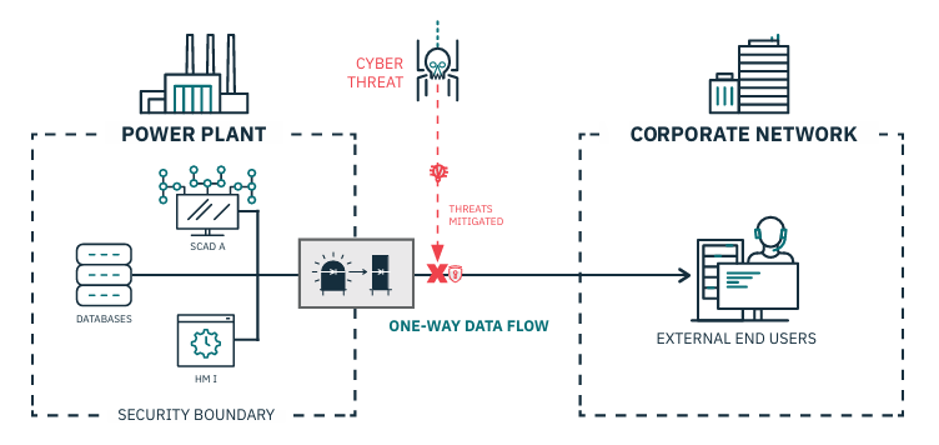
Owl Protocol Filtering Diodes create a hardware-enforced path between networks. In a one-way deployment, approved operational data can move from the protected facility network to IT, DCIM, SOC/SIEM, or cloud systems, while the hardware removes the network return path across that connection. Protocol filtering at the FPGA layer validates and reconstructs approved flows in hardware.
Protect uptime with battle-tested, deterministic separation
Remove the inbound network path across designated OT-to-IT or OT-to-cloud connections, reducing exposure to remote intrusion, stolen credentials, firewall exploits, and rule changes.
Preserve visibility and incident readiness
Continue exporting alarms, historian data, logs, environmental data, and security telemetry so operations and security teams can monitor the facility without exposing protected control systems through the same connection.
Scale security to the data rate and environment
Support compact, rack-mounted, DIN-rail, bidirectional, and high-throughput architectures—from facility controls and edge sites to high-volume AI and hyperscale environments.
Hardware-Enforced Security at the Data Center OT Boundary
Software-defined controls decide whether traffic may pass. A hardware-enforced one-way path is physically incapable of carrying network traffic in the reverse direction. This gives operators a deterministic boundary for flows that do not need to be two-way, the same defense grade cybersecurity principle that secures tactical communications in military and government networks.
- BMS, EPMS, SCADA, generators, UPS, switchgear, cooling, sensors, and historians.
Built for Every Data Center Operating Model
Hyperscale and AI data centers
- Protect onsite generation, cooling, and facility controls at scale
- Export large volumes of operational, network, and security telemetry
- Support high-density environments without turning the security boundary into a performance bottleneck
Best-fit product path
Owl Talon Torrent for high-throughput flows; Owl Talon One for facility and control boundaries
Colocation and multi-tenant data centers
- Protect shared facility infrastructure from corporate, tenant, vendor, and external networks
- Preserve visibility needed to support uptime commitments and customer trust
- Standardize security architecture across sites while keeping tenant and facility responsibilities distinct
Best-fit product path
Owl Talon One, with Talon Torrent where consolidated throughput warrants it
Enterprise and edge data centers
- Protect critical facility systems with limited local cybersecurity staff
- Fit security into space-, power-, and infrastructure-constrained locations
- Centralize monitoring without exposing remote facility networks
Best-fit product path
Owl Talon One 1U, PCIe, or DIN-rail form factors as appropriate
Data Center Cybersecurity Use Cases

Secure OT telemetry to IT, SOC, SIEM, or cloud
Move alarms, logs, environmental data, historian data, and equipment status out of protected facility networks without maintaining a return path on the same connection.

Isolate power and cooling control systems
Segment generators, UPS, switchgear, cooling plants, BMS, EPMS, and SCADA from less-trusted enterprise and external networks.

Protect high-volume AI and HPC environments
Export large telemetry, log, file, database, and sensor streams at up to 100 Gbps while retaining hardware-enforced directionality.

Centralize multi-site operations safely
Provide enterprise operations teams with facility visibility across distributed data centers while keeping local control environments protected.

Monitor cyber-recovery vaults
Export health, monitoring, and security data from isolated recovery environments to routine data center operations. Owl Data Diodes for Dell PowerProtect Cyber Recovery

Enable tightly controlled two-way workflows
Where remote administration, updates, or other return flows are genuinely required, use paired, policy-enforced one-way paths in an approved bidirectional architecture rather than implying a pure one-way connection can support interactive access. Owl Talon One
Owl Solutions for Data Center Security
Owl Talon® One
Delivering flexible, hardware-enforced security for facility OT, control rooms, enterprise data centers, and edge environments, the solution supports throughput of up to 1 Gbps and multiple simultaneous protocols and data types. It deploys in 1U, DIN-rail, and bidirectional configurations, with high-availability options for mission-critical operations.
Owl Talon Torrent®
Built for hyperscale, AI, HPC, and other data-intensive environments, this solution provides high-speed, high-assurance one-way transfer at up to 100 Gbps. It’s available in 1U, 2U, and card-kit configurations and supports up to 16 secure one-way channels, depending on configuration. Multi-protocol transfer handles high-volume telemetry, files, and database replication, and the platform is U.S. Government-validated as a Protocol Filtering Diode.
Connect to the Systems Your Data Center Already Uses
Monitoring and events
- Syslog
- SNMP traps
- SMTP
Industrial and facility data
- OPC DA/A&E
- OPC UA
- MQTT/MQTTS
- Modbus
Files and data movement
- RFTS
- SFTP
- TCP
- UDP
Time and visibility
- NTP
- Virtual screen view
Historian
AVEVA PI/Owl PI Transfer Service
Cloud and analytics
Supported one-way export architectures to cloud platforms
Support Defensible Data Center Security Architecture
Data centers may face different obligations depending on ownership, customers, geography, and the critical services they support. Owl can help organizations implement stronger segmentation, boundary protection, controlled information flow, and OT monitoring architectures aligned with widely used frameworks.
Potential frameworks to address:
- NIST Cybersecurity Framework 2.0
- NIST SP 800-82 Rev. 3, Guide to Operational Technology Security
- NIST SP 800-53 controls for boundary protection and information flow enforcement, where applicable
- IEC 62443 for industrial automation and control system security
- ISO/IEC 27001 as part of the broader information-security management program
- Sector- or customer-specific obligations such as NERC CIP, DORA, NIS2, FedRAMP, or FISMA only where the data center and deployment are actually in scope
Data Center Cybersecurity FAQs
Data center OT security protects the physical systems that power, cool, monitor, and operate a facility — including generators, UPS equipment, BMS, EPMS, SCADA, and cooling plants — from unauthorized access or control. A cyber event in these systems can directly cause physical downtime, not just a data breach.
Data diodes create a hardware-enforced one-way path from protected facility OT networks — including generators, UPS, and cooling systems — to IT, DCIM, or cloud destinations. Because the hardware physically cannot carry return traffic, attackers cannot reach protected systems through that connection, regardless of credential theft or firewall exploits.
IT/OT convergence connects facility controls — BMS, EPMS, SCADA — to enterprise and cloud platforms. Each integration point is a potential attack pathway. An adversary who compromises IT, credentials, or an upstream vendor can traverse conventional two-way connections toward the systems responsible for power, temperature, and uptime.
Owl Protocol Filtering Diodes create a hardware-enforced boundary between protected facility OT and external destinations. Approved operational data — alarms, historian logs, environmental telemetry — flows outbound to DCIM, SOC/SIEM, or cloud analytics. The inbound network path is physically removed, eliminating remote intrusion risk across that connection.
Yes. Owl Protocol Filtering Diodes preserve full operational visibility while removing the inbound attack surface. Alarms, historian data, environmental sensors, security telemetry, and SCADA logs continue flowing outbound to DCIM, NOC/SOC, and SIEM platforms — so operations and security teams maintain complete situational awareness without exposing protected facility controls.
Protect the Systems That Keep Your Data Center Online
Map your critical facility systems, identify which data flows truly need to be two-way, and determine where hardware-enforced separation can reduce risk without sacrificing operational visibility.