
Owl Incident Response Diode™: Secure Forensic File Collection.
The Owl Incident Response Diode (IRD) is the first purpose-built solution for hardware-enforced, one-way transfer from compromised endpoints. Protect enterprise, critical infrastructure, and mission networks from the inside out.

Your IR process has a security problem.
Every time a responder connects to an infected host, your clean network is exposed. In a power grid, water treatment facility, or nuclear plant, it’s a mission failure. On a classified or tactical network, it’s a compromise you can’t walk back. Incident response can’t wait — but it can’t afford to introduce the threat it came to stop. Owl IRD delivers hardware-enforced, one-way forensic data transfer: off the endpoint, out of the field, and never back into the mission network.
The First Diode Built Specifically for Mission-Critical Incident Response.
Owl Incident Response Diode (IRD) brings Protocol Filtering Diode assurance to the endpoint — purpose-built for incident responders who need a faster, safer, and more defensible alternative to conventional USB-based collection.
Bring One-Way to the Moment of Response.
Where standard data diodes are built for continuous, always-on network flows, Owl IRD is a Protocol Filtering Diode built for the moment of response, giving investigators a one-way, protocol-filtered collection path off compromised endpoints that contains threats instead of spreading them.
Built for How Responders Actually Work.
From field triage to forensic lab intake to malware sample transfer, Owl IRD fits into existing incident response workflows without retraining teams or rebuilding processes, just a quick, consistent collection path every time.
One Tool, Many High-Assurance Requirements.
Compact enough for a go-bag and flexible enough for the lab, Owl IRD also supports secure file transfer between enclaves and one-way mission data downloads to tactical equipment wherever the mission demands it.
Don't let your collection method become part of the incident.
Every improvised USB transfer, direct connection, or ad hoc “read-only” workaround is a risk your forensic chain of custody can’t afford. Owl IRD gives incident responders a consistent, defensible, hardware-enforced collection path — whether you’re triaging in the field or moving sensitive files across classification boundaries. See it live and bring your questions.
How Owl IRD Works: Collect evidence forward. Leave threats behind.
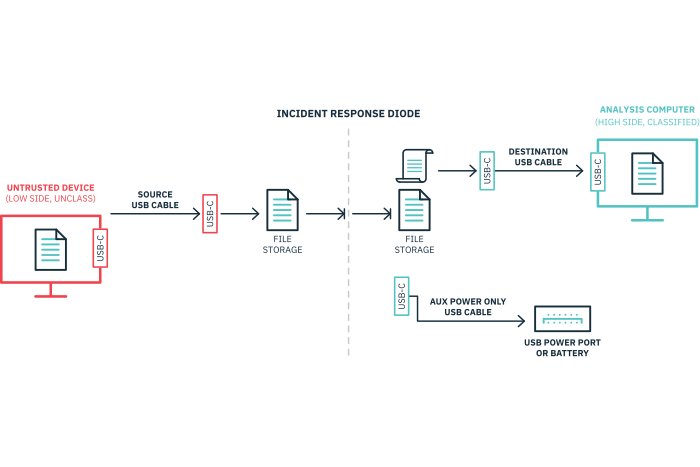
One-way isn’t a setting, it’s the architecture. Owl IRD presents as two USB storage devices: one on the untrusted side, one on the trusted side. Data flows in one direction only, enforced at the hardware level by Owl’s Protocol Filtering Diode technology. No network connection. No return path. No risk of callback or reinfection.
How it works:
- Plug the untrusted end into the compromised endpoint
- Plug the trusted end into your clean analysis system
- Copy files to the untrusted drive as normal
- PFD technology moves data forward — one way, hardware-enforced
- Files arrive on the trusted side; no return path is ever created
Where Owl IRD Goes to Work: Use Cases
From compromised endpoints to forensic labs to classification boundaries, Owl IRD replaces improvised collection methods with a consistent, defensible workflow. Whether your team is triaging in the field, processing evidence in the lab, or moving sensitive files across enclaves, IRD enforces one-way transfer at the source — so every collection is safer, faster, and built to hold up to scrutiny.
Where responders rely on Owl IRD:
-
- Field incident response: Collect evidence off compromised endpoints without risking reinfection or callback.
- Low-to-high evidence transfer: Move malware samples and forensic files across classification boundaries defensibly.
- Secure enclave file transfer: One-way file transfer between enclaves — no return path, no exposure.
- Tactical mission data downloads: Push mission data to tactical equipment without opening a return path.
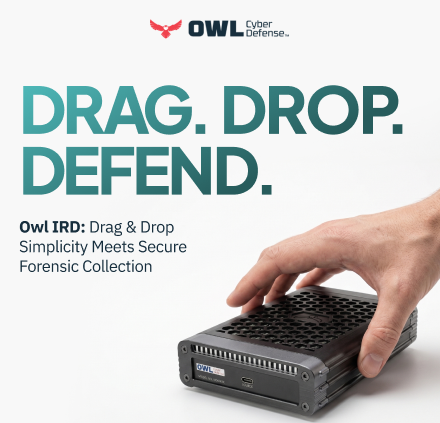
One-Way Security, Everywhere: Owl IRD + Owl Talon
| Capability/Feature | Owl IRD | Owl Talon One | Owl Talon Torrent |
|---|---|---|---|
| Hardware-Enforced One-Way Transfer | |||
| U.S. Government Evaluated Protocol Filtering Diode (PFD) | |||
| Primary Use Cases | Field IR, forensic lab intake, and low-to-high evidence transfer off compromised endpoints. | OT/IT logging, data/file transfer, and telemetry across critical network boundaries. | Bulk data/file transfer for high-speed flows across critical network boundaries. |
| Form Factor(s) | USB | DIN-Rail, 1x1U, Bidirectional | 1x1U, 2x1U |
| Permanent Network Installation for Continuous Transfer | |||
| Portable / Field-Deployable | |||
| Deployment Point | Between single endpoint & trusted analysis workstation | Between networks (OT-IT, high-low, etc.) | Between networks (OT-IT, high-low, etc.) |
| Throughput Speed | Up to 1 Gbps+ | Up to 1 Gbps | Up to 100 Gbps |
| Connection Type | USB | Network interface | Network interface |
| Deployment Environment | Field / forensic lab | Network boundary | Network boundary |
What’s standing between you and secure incident response?
We’ve brought decades of one-way security expertise to the forensic evidence collection problem no one else has solved. Owl IRD is the first purpose-built solution for hardware-enforced, one-way transfer from compromised endpoints — protecting enterprise, critical infrastructure, and mission networks from the inside out. Talk to our team to see how IRD fits your environment.