Owl Evolution Summit 2026: Mission Possible
Leaders from government, industry, and the operational community came together to tackle
what’s next for trusted, hardware-enforced security. From the tactical edge to critical
infrastructure, the day pushed past buzzwords toward practical ways to secure the mission.
Watch the sessions on demand below.
Experience the Highlights of the Owl Evolution Summit
Watch exclusive keynote moments and panel discussions from the 2026 event. Delve into expert insights on mission-critical decisions, next-generation cyber strategies, and the operational realities of modern defense.
Scroll down to explore video highlights and see how leading voices are shaping the future of security and resilience.
Welcome Keynote: Mission Possible
Scott Orton, CEO, Owl Cyber Defense
Scott Orton opened the summit with a progress report on Owl’s three goals: move the industry forward, make the technology easier to use, and give customers command over it. He covered the pocket diode (now in production), iOS and iPadOS approved for classified environments, and the new XD Chat. He also previewed a consolidated CDS that grows with the customer and a diode platform that third parties can build on. His closing message was that your data, schemas, and flows should go with you to any CDS.
Featured Fireside Chat Keynote: Streamlining, Modernizing, and Securing Infrastructure in an AI Era
Harry Wingo, Founder of Wingo Strategies LLC, former Deputy National Cyber Director, in conversation with Scott Orton
Drawing on history, from the Greek navy to Willow Run, Harry Wingo made the case that prosperity and security are the same story. He explored how small modular reactors and AI-driven demand are reshaping critical infrastructure, and why that infrastructure needs nuclear-grade, hardware-enforced protection. He also asked whether AI sandboxes should be built on more than logic alone. His 90-day challenge was to craft a tight story on how cross-domain solutions can speed up the nuclear renaissance.
Use Case: Code can’t contain code. Give AI a boundary it can’t argue with.
As AI agents gain access to sensitive data and networks, containment can’t depend on application-layer controls alone.
2027 Prediction Sneak Peek: Data Diodes+
Tim Fall, CTO Owl Cyber Defense, and Carolyn Ford, SVP Marketing Owl Cyber Defense
Data diodes have been defined as one-way transfer devices for 25 years, but the threat has moved into the data itself. Using a rental-car-lot analogy, Tim Fall walked through the “Data Diode Plus” ladder: simple, protocol-filtering, syntax-verifying, and content-aware diodes, up to full cross-domain solutions. He also explained why protocol-filtering diodes are a near-zero-effort upgrade, and offered a sneak peek at where the industry is heading in 2027.
Secure Data Movement Makes the Mission Possible
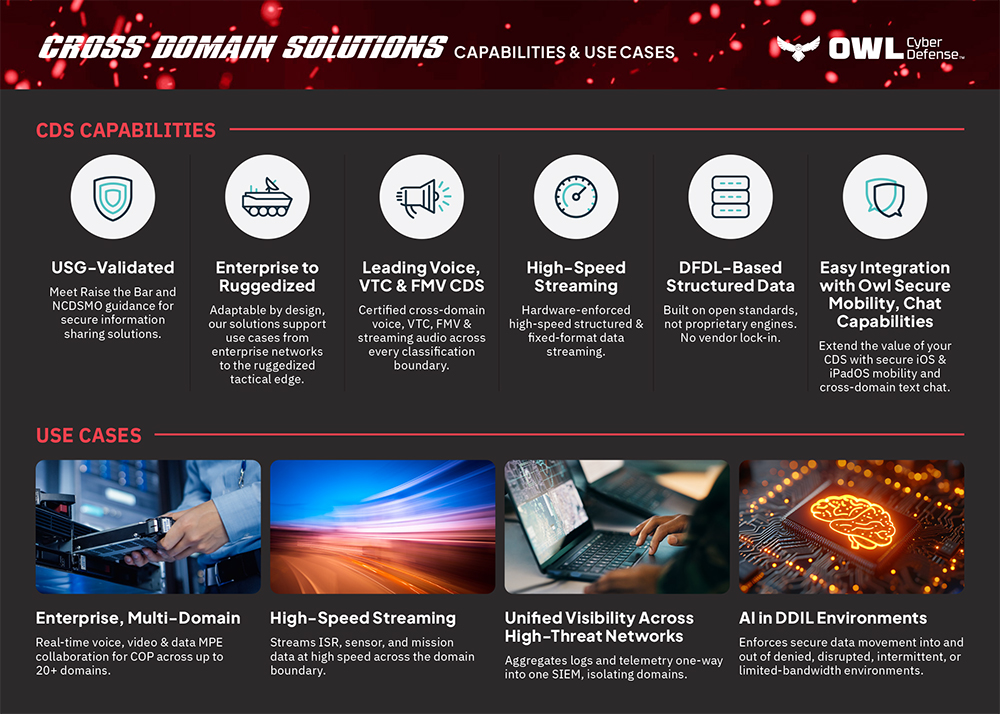
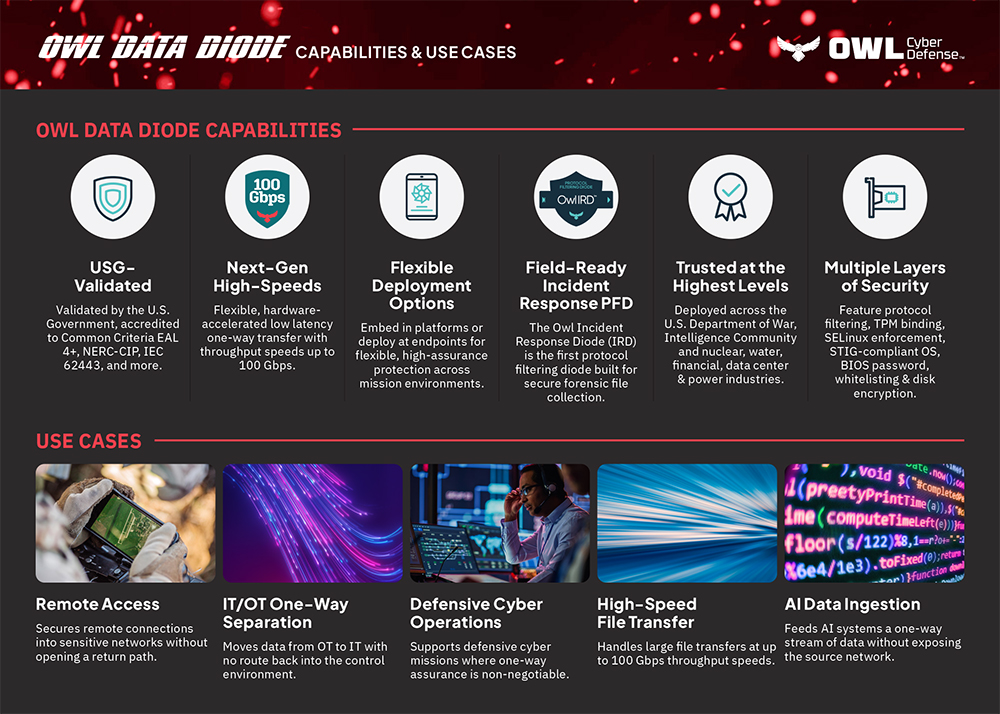
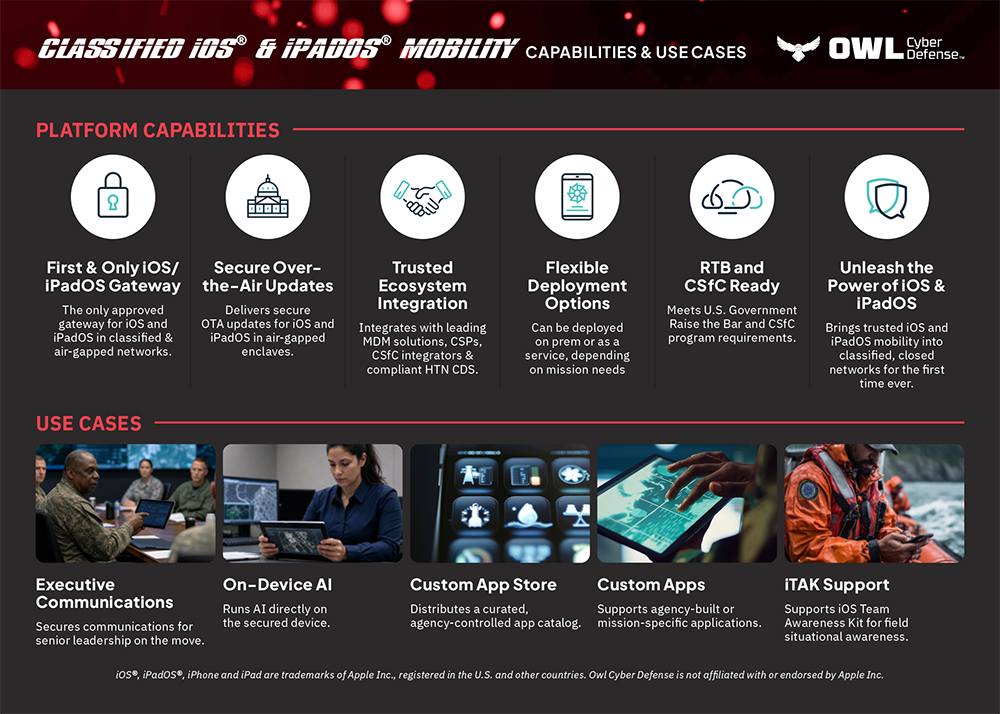
From the enterprise to the tactical edge, Owl Cyber Defense moves mission data across boundaries without opening a path back. Our U.S. Government-validated portfolio covers three areas. Owl Data Diodes provide hardware-enforced one-way transfer at up to 100 Gbps. Owl Cross Domain Solutions share voice, video, streaming and structured data across 20+ classification domains. XD Tyton is the first and only approved gateway that brings iOS and iPadOS into classified and air-gapped networks. Explore the capabilities, use cases and product suites below.
Surviving the Real-World COMSEC Gauntlet
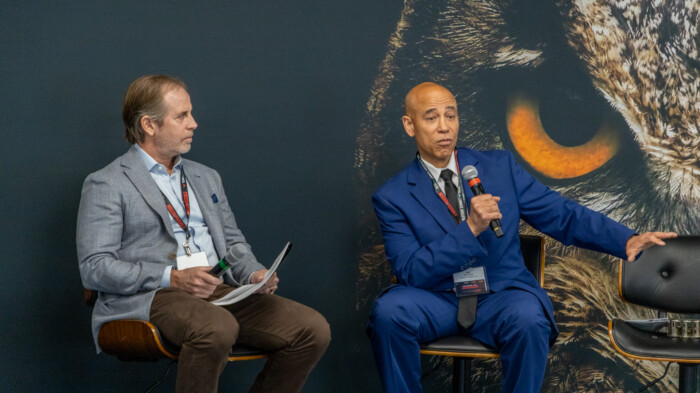
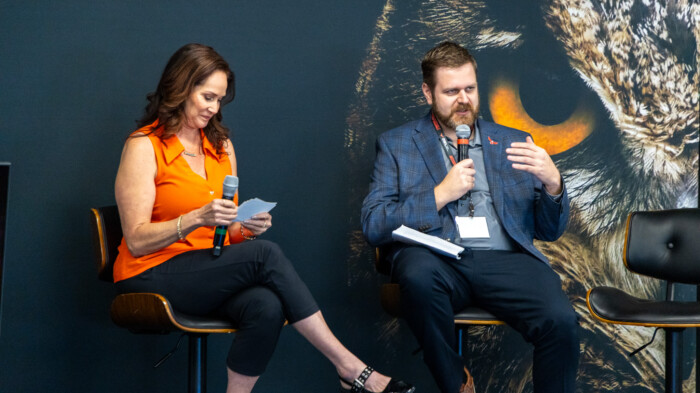
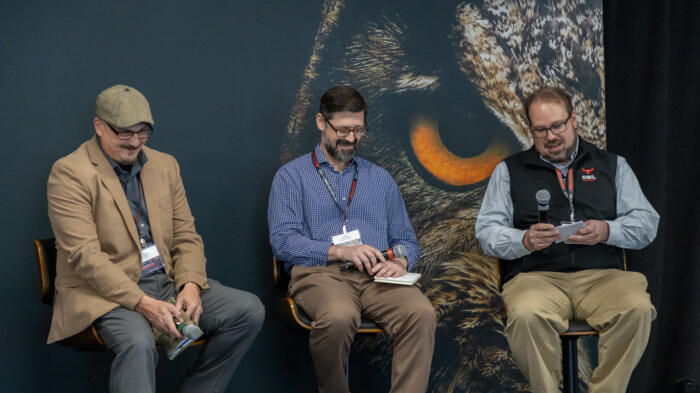
Sean McQuade (moderator) Senior Director, Product Management, Brian Delgado, Army C2, and Scott Miller, Product Manager for Mercury Systems’ Secure Processing Division | Anti-tamper specialist
Security designers and operators shared a stage to say what they usually only say in separate rooms. The panel covered what security feels like on a network with roughly 200,000 edge nodes, and why solutions that ignore bandwidth, logistics, and maintainability end up sitting in a vault. They agreed on modular designs, risk-based protection matched to the perishability of the data, and bringing security into the conversation from day one.
Use Case: Rugged Cross Domain Solutions for the Tactical Edge
Owl Rugged Cross Solutions bring trusted, RTB-compliant cross domain data transfer and collaboration capabilities to purpose-built low-SWaP platforms for mobile, airborne, shipboard, and forward-deployed environments.
Facing the Rise of the Super Villains: Zero Trust’s Critical Gap
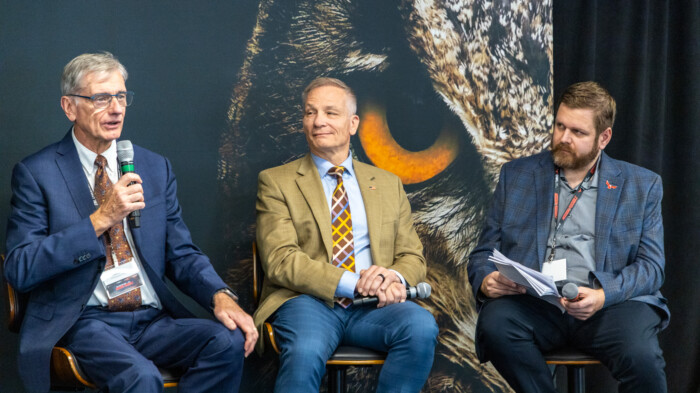
Tim Fall (moderator), Technical Director, DAF Cyber Resiliency Office for Control Systems (CROCS), and Glenn Wadden, CTO, Founder of VTScada by Trihedral
Is zero trust a buzzword or a real framework? Two defense OT and critical infrastructure leaders said the principles hold up but have a hard time landing in plants and utilities. They shared candid field stories on IT/OT mismatches, bad as-built drawings, and the limits of “we’ll just go manual.” They also offered low-cost starting points: verify what you actually have, rehearse manual mode, and use free training. The takeaway was to ask three words in every cyber discussion: “What about OT?”
Use Case: Zero Trust Security for Cross Domain Environments
Cross domain solutions and data diodes don’t just support Zero Trust—they physically enforce it.
Real-Time Collaboration, Secure Communication & Trusted Information Sharing Across the Defense Enterprise
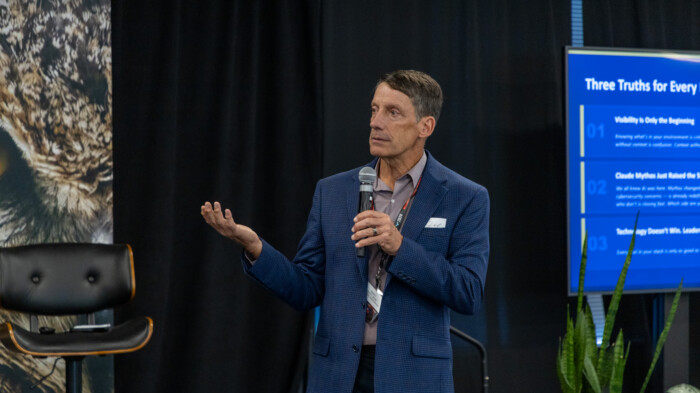
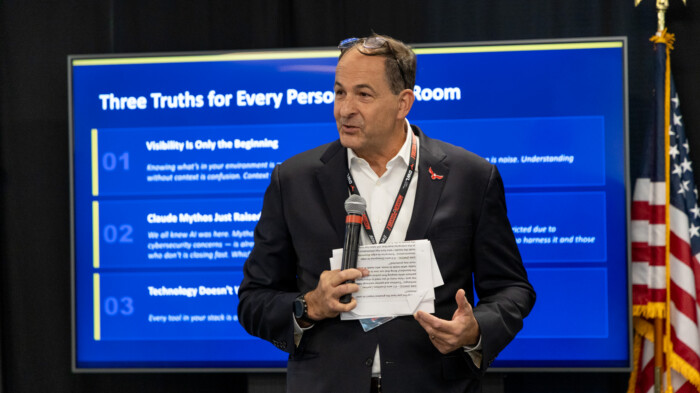
Lt. Gen. Robert J. Skinner, USAF (Ret.) Former Director, DISA · Commander, JFHQ-DoDIN
General Skinner opened with the threat picture: the PRC as the strategic challenge, decades-old vulnerabilities, and AI shrinking the timeline. He argued that people are the real mission, and that visibility needs context to be useful. His line “speed without trust is noise; trust without speed is history” framed a Q&A on hardware-based boundary security, continuously validated trust, true government-industry partnership, and why time is now worth more than money. His closing point was that technology doesn’t win, leadership does.

Secure Connectivity for High Threat Network Environments
Enable secure military communications over high‑threat and high security networks with hardware‑enforced data diodes and Cross Domain Solutions that protect classified missions while allowing real‑time collaboration
Use Case: Defense Communications
Hardware-Enforced Data Center Security
Protect the power, cooling, building-management, and control systems that keep your data center online—while safely moving operational and security telemetry to IT, SOC, SIEM, DCIM, and cloud environments.
Use Case: Data Center Security




Policy Can Be Argued With. Hardware Can’t.
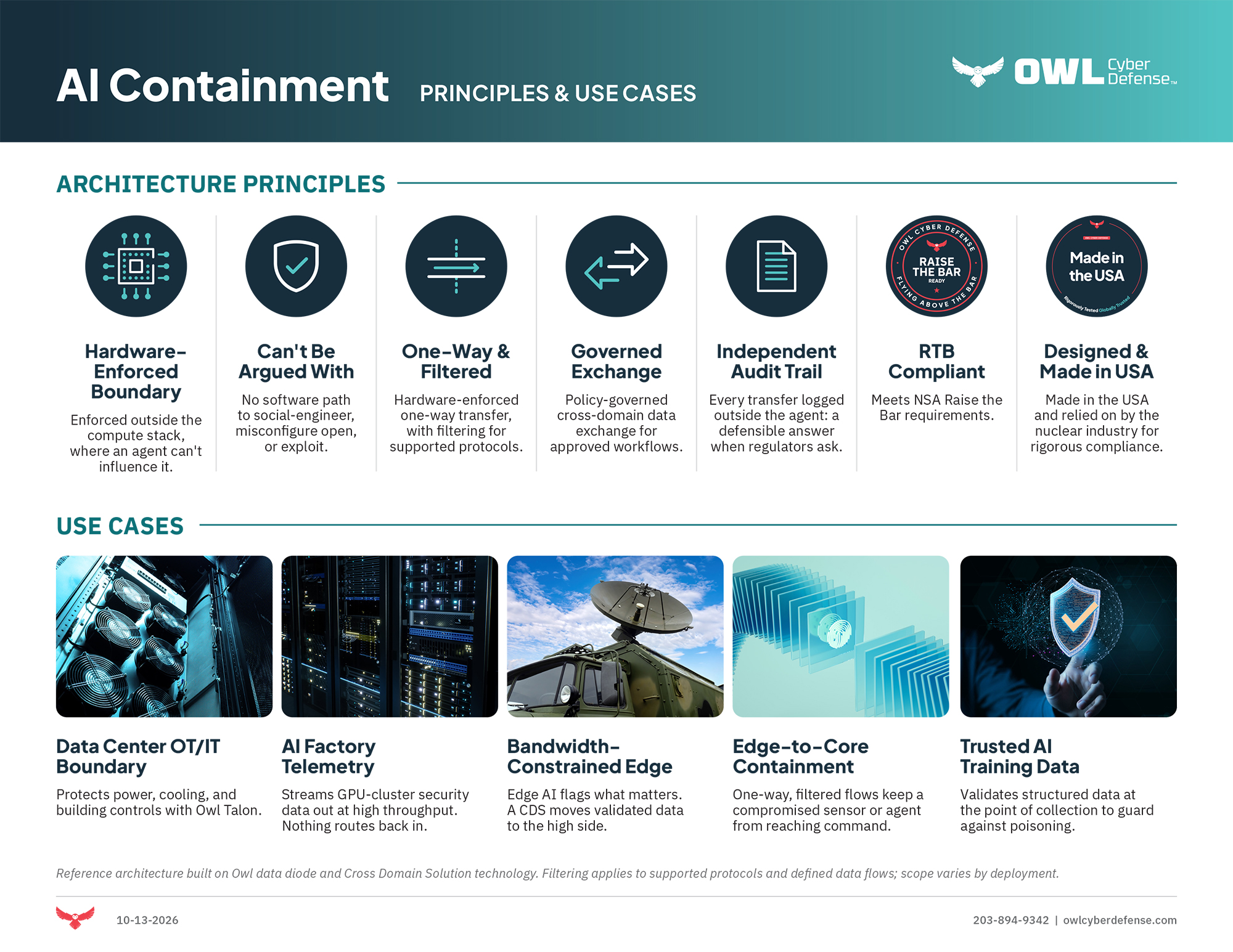
Application-layer controls alone can’t contain autonomous AI agents. Owl’s AI Containment reference architecture places the boundary outside the compute stack, where an agent can’t influence it. Built on Owl’s data diode and Cross Domain Solution technology, it enforces one-way transfer where required, filters supported protocols, and governs cross-domain exchange for approved workflows. Every transfer is logged, so you have a defensible record when regulators ask. It protects data center OT/IT boundaries, AI factory telemetry, edge-to-core flows and training data, and it meets NSA Raise the Bar requirements.

We Achieved Mission Success
Thank you for joining us at the summit! Whether you were with us in person or tuned in virtually, we’re grateful you spent the day with national security experts, operational leaders, and cybersecurity innovators. Your questions, ideas, and conversations made the day what it was. We hope you’re leaving with new insights, practical tools, and connections that help you make your impossible missions possible. We look forward to continuing the conversation and seeing what you accomplish next.
Former Director, DISA · Commander, JFHQ-DoDIN
Retired Lt. Gen. Robert J. Skinner served as Director of the Defense Information Systems Agency and the Commander of the Joint Force Headquarters-Department of Defense Information Network.
As former Director of the Defense Information Systems Agency, Lt. Gen. Skinner managed a global network and led nearly 19,000 service members, civilians and contractors who plan, develop, deliver and operate joint, interoperable command and control capabilities and defend an enterprise infrastructure in more than 42 countries. This mission directly supports the President, Secretary of Defense, Joint Chiefs of Staff, combatant commanders, U.S. Department of Defense components, and other mission partners across the spectrum of, competition, combat and combat support operations.
As former Commander of Joint Force Headquarters-Department of Defense Information Network, he was in charge with leading unified action across DoD to secure, operate and defend the DoDIN. He led the establishment of DoDIN priorities and directed threat-informed actions through formal planning and future operational initiatives, as well as the command and control of daily unified network operations, cyber security actions and defensive operations on the DoDIN
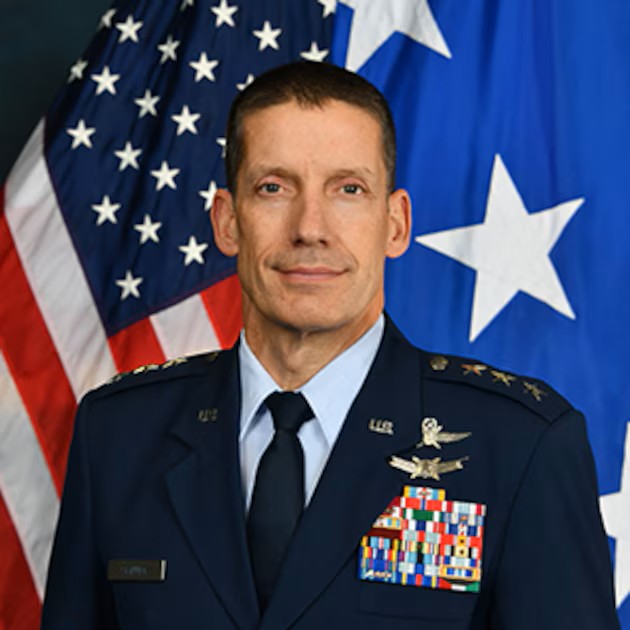
Founder of Wingo Strategies LLC and former Deputy National Cyber Director
Harry Wingo is the Founder of Wingo Strategies LLC and former Deputy National Cyber Director. A graduate of Yale Law School and the U.S. Naval Academy, Harry is a Navy SEAL veteran and former counsel to the U.S. Senate Commerce Committee and senior policy counsel at Google. He formerly taught cyber policy and strategy at the National Defense University, and has testified on drone innovation and security before the U.S. Senate.
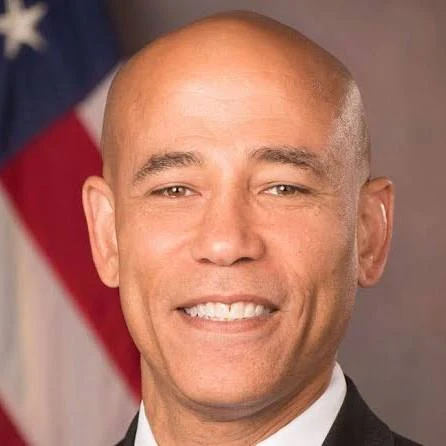
Team Lead, C2 Trailboss, CPE C2IN Capability Initiative, U.S. Army
Brian C. Delgado is a defense technology executive and Army network modernization leader with more than 29 years of military and industry experience spanning operational formations, acquisition, systems integration, and emerging technology. As Technical Director for Sheepdog Engineering and Technology, he leads the strategy development for system integration, engineering, and technical services in support of Army modernization.
Mr. Delgado also serves as Capability Initiative Lead for the Command and Control (C2) Trail Boss System-of-Systems Integration Team at the LTG James M. Gavin Joint Innovation Outpost (JIOP), where he works across operational units, acquisition organizations, government technology developers, and industry to accelerate emerging capabilities into operational formations.
His career includes key roles supporting Capability Program Executive (CPE) Command and Control Information Network (C2IN), Army Futures Command’s (AFC) Network Cross-Functional Team (N-CFT), Forces Command (FORSCOM), Special Operations, and the 82nd Airborne Division, with extensive involvement in the development and operationalization of the Integrated Tactical Network (ITN), Capability Sets, and Next Generation Command and Control (NGC2).

Technical Director, DAF Cyber Resiliency Office for Control Systems (CROCS)
Pioneer in operational technology (OT) cybersecurity with 30+ years of military, federal, and commercial experience leading mission-critical cyber initiatives. Currently serving as the Department of the Air Force’s first Senior Executive focused on OT cyber resilience, overseeing a $2B+ portfolio of critical infrastructure protection. Recognized as DoD’s foremost expert in control systems cybersecurity, providing strategic direction for Air Force and Space Force global operations.
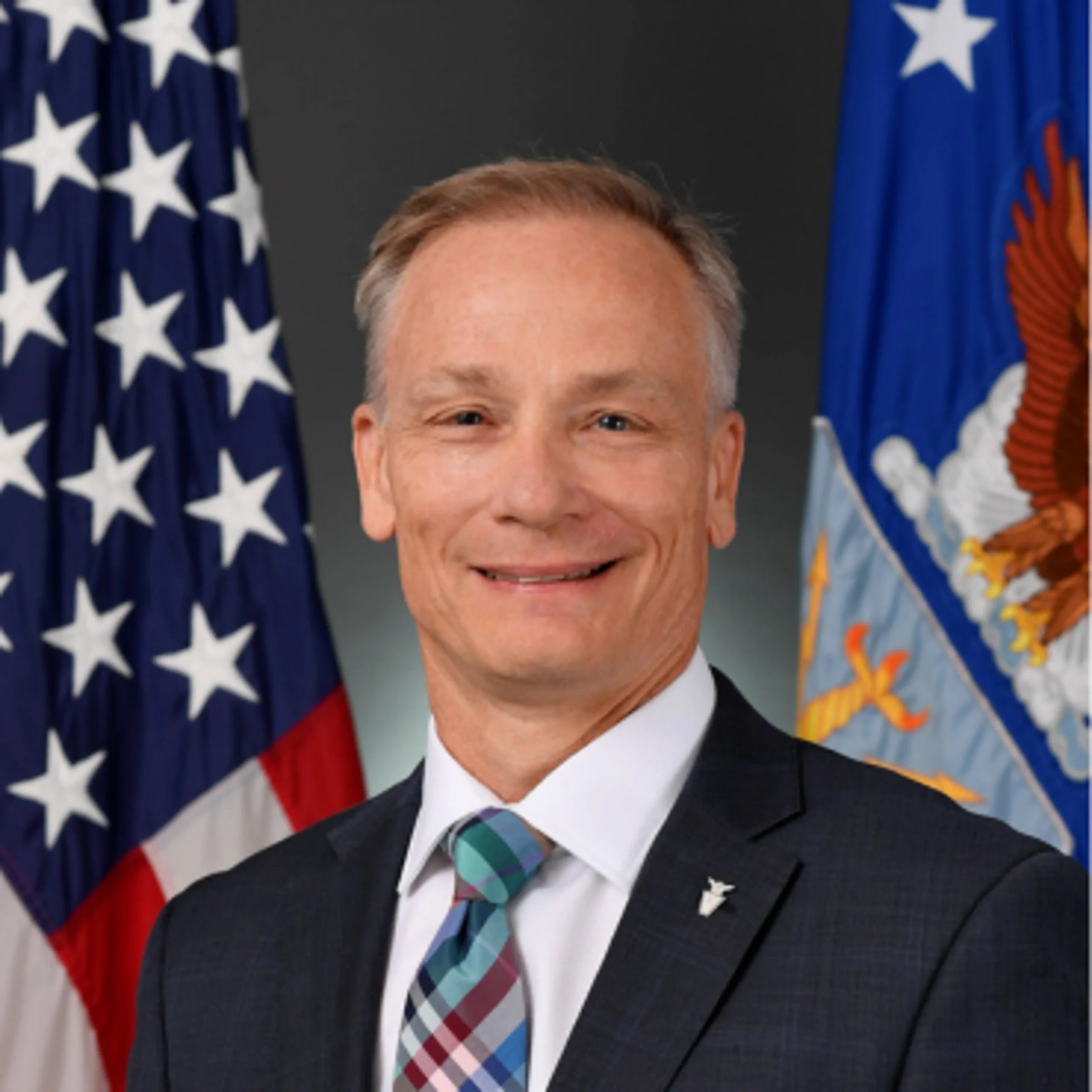
CTO, Founder of VTScada by Trihedral
Glenn founded Trihedral in 1986 with the vision to revolutionize automation by creating software to dramatically reduce the complexity of deploying the highest quality SCADA systems. A focus on people and creating leading technology are his key motivators. After 40 impressive years as Trihedral’s President, he now maintains the role of CTO and chief software architect with the help of exceptionally talented staff. A lifelong Nova Scotian, he earned degrees in Engineering Physics at Dalhousie University, and a Master of Science in Electrical Engineering at the University of Minnesota.

Product Manager for Mercury Systems’ Secure Processing Division | Anti-tamper specialist
Scott is a system security SME with more than 20 years’ experience in breaking and defending electronic systems with a particular focus on reverse engineering. Examples include reverse engineering and modifying electronics and software to bypass and/or counter security features across Automotive, Aerospace, & Defense, and producing a line of reverse-engineering resistant cryptography suitable for mobile banking. Scott presently serves as a Product Manager for Mercury Systems’ Secure Processing division, where he focuses on commoditizing advanced volume protection solutions. Scott obtained a Ph.D. in Computer Science from Purdue University in 2013, and resides in West Lafayette, IN with his wife and children, where his security skills are actively honed keeping the raccoons out of his wood shop.
CEO, Owl Cyber Defense
Scott Orton brings in-depth defense industry experience to the role of Owl’s Chief Executive Officer. Scott has an extensive background in anti-tamper and has managed programs developing and fielding the latest in secure processing technologies for militarily critical weapon systems. Prior to joining Owl Cyber Defense, Scott led Mercury Systems’ edge processing business and held multiple roles with Raytheon.

Senior Director, Product Management, Owl Cyber Defense
Shaun McQuaid is Senior Director of Product Management at Owl, where he leads product strategy for the company’s rugged and high-speed data diode portfolio. He brings a systems engineering background and years of experience in tactical deployable hardware and mission critical technology, including senior product and program leadership at Mercury Systems. Shaun works at the intersection of engineering, customers, and market need, making sure Owl builds what defense, intelligence, and critical infrastructure customers need to move data securely across their most sensitive networks.
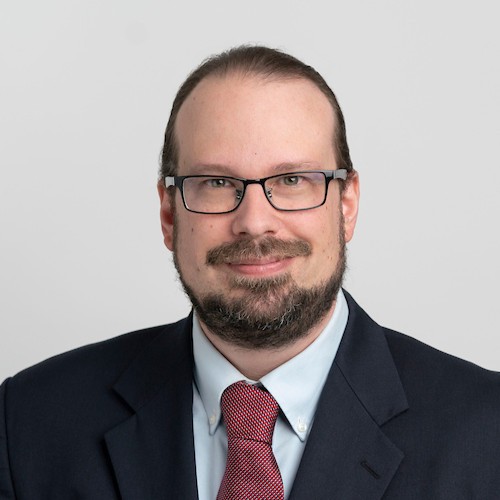
LT. General US Marine Corps (Ret) SVP Strategic Programs, Owl Cyber Defense
LtGen, USMC (Ret.) Dan joined Owl after serving as the Commanding General of the Marine Forces Cyberspace Command, the first Deputy Commandant for Information (responsible for all USMC Cyber, Intelligence, Information and Space capabilities), and, most recently, the Joint Staff Director who designed, developed, trained, educated and adapted the Joint Force for 21st Century warfare. As the Director of Marine Corps Capability Development, he led requirements for all USMC ground programs and the Commandant’s Force Structure Review for the 21st Century Marine Corps. As an infantry leader, Dan led a main effort Task Force in the attack into Iraq, stabilized the second largest Iraqi province, served as the Operations Officer for Afghanistan, and commanded the 1st Marine Division, the USMC’s largest.

Chief Technology Officer, Owl Cyber Defense
Timothy (Tim) Fahl serves as Chief Technology Officer (CTO) at Owl Cyber Defense, where he oversees the development of the company’s advanced cross-domain solutions and data diodes technologies, designed to exceed mission requirements. Previously, Tim served as Chief Architect and Product Manager for Owl Cyber Defense, and Lead Software Engineer for Tresys Technology prior to the companies’ merger in 2019. This strategic move created the number one boundary security product and services company in the world with a continued focus on the U.S. government, defense and global critical infrastructure markets. Tim’s expertise carried over as he now leads the charge in meeting the needs of customers that demand absolute assurance and uncompromising security.

SVP Global Marketing, Owl Cyber Defense
Carolyn brings over two decades of experience as a marketing leader in global high-tech firms, with 15 years focused on public sector marketing. Carolyn entered the cybersecurity space in 2009 with Raytheon Cyber Products, where she held multiple roles and communicated the vision of secure information sharing and insider threat strategies to government agencies. In 2021 she established Dynatrace’s public sector marketing team. She also spent several years as a product manager in the technical and online industries and ran her own consulting company, as an instructional designer and trainer for over a decade. Carolyn is the creator and host of the successful podcasts “To the Point Cybersecurity” and “Tech Transforms,” that engage with thought leaders in industry and government to discuss critical issues. “To the Point Cybersecurity” was named one of the top 30 Federal IT influencers in 2019 and 2020 by FedTech magazine.