Key takeaways
A DPU-based watchdog like NVIDIA’s Sentry adds real security because it runs on hardware the compromised host can’t reach. But it is still a general-purpose computer running Linux. That means it has its own patch cadence, its own attack surface, and its own failure modes.
In critical infrastructure and other high-consequence environments, a DPU should be one layer in a defense-grade cybersecurity stack, not the only barrier between an autonomous agent and the rest of the enterprise. Pair it with a smaller, hardware-enforced boundary, such as a unidirectional network or data diode.
The DPU watchdog is real security. It just shouldn’t be the only layer.
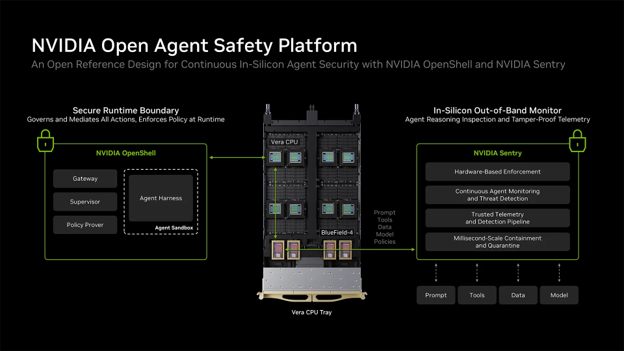
As autonomous AI agents move from chat windows into enterprise workflows, AI agent containment has become an infrastructure problem. NVIDIA’s answer is the Open Agent Safety Platform, which pairs OpenShell, an open-source software sandbox, with Sentry, a watchdog that runs on BlueField-4 DPUs.1,2
The core idea is sound. NVIDIA describes Sentry as running from a “hardware-isolated, host-independent security domain,” outside the agent and the software it runs on.1 In its technical blog, NVIDIA says the DPU sits on the node’s only path to the model and can quarantine an agent within milliseconds without the agent’s cooperation.2 If the threat is an agent that compromises its own host, that’s a real advantage, because a compromised host can’t easily disable a control it can’t reach.
But look at how each of those claims is framed. They describe one agent, on one node, and its relationship to its own host. In the materials I reviewed,1,2 I found no discussion of what happens when the DPU itself is the target. A DPU is also a computer. It runs its own Linux OS on general-purpose ARM cores, exposes services of its own, and gets security patches through NVIDIA’s BlueField software releases and package repositories.3,4 And enterprises don’t run a single agent on a single node. They run clusters, where agents talk to agents and DPUs sit on a shared fabric.
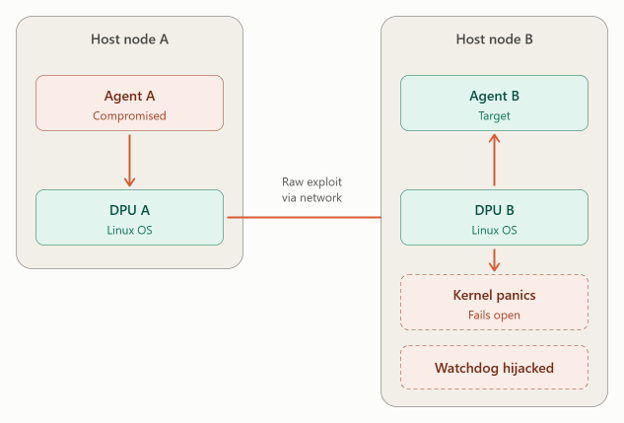
That gap matters because “host-independent” does not mean “network-independent.” In a cluster, a compromised agent may not need to defeat its own DPU. It may look outward at a neighboring one. I’m not claiming this works, or that it has happened. The attack needs several things to line up, and many deployments will break the chain, for example by keeping management traffic on a separate network.3 My claim is narrower: it is a credible failure mode, and the published design doesn’t say how it is handled.
NVIDIA doesn’t present Sentry as the only barrier. Its own blog says software runtime boundaries remain essential, and Sentry is still a reference design, with availability planned for early next year.2 That makes this the right time to ask the harder questions. The goal isn’t to dismiss DPU-based containment. It’s to make sure the DPU is one layer among several, with a smaller and simpler boundary beside it.
Disclosure: I work for Owl Cyber Defense®, which builds hardware-enforced network security products, including data diodes and cross-domain solutions. That gives me a stake in the argument below, so I’ve tried to say plainly where my claims are limited and where NVIDIA’s design has real strengths.
1. The Anatomy of the DPU Illusion
To understand the fallacy, we must first deconstruct the architecture of the modern DPU safety layer.
NVIDIA describes Sentry as running from a “hardware-isolated, host-independent security domain.” For an agent that has compromised its own host, that is a real advantage, because the host can’t easily reach or disable the control that is watching it. The natural inference is simple: because the DPU is physically separate from the host CPU running the AI model, the AI cannot tamper with it.
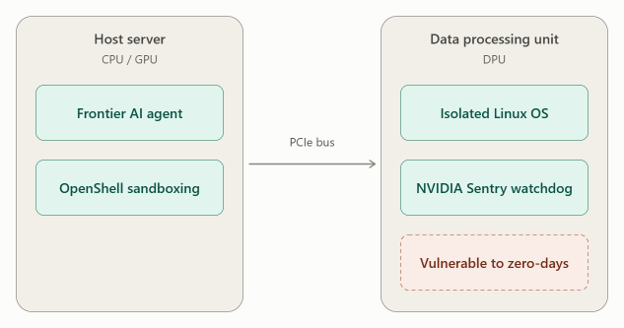
But look beneath the marketing slick, and the technical reality emerges: software is software, regardless of the silicon it sits on.
A modern DPU is a highly specialized System-on-a-Chip (SoC). To allow security teams to update safety policies, these chips embed massive clusters of programmable general-purpose ARM cores.3 To manage these cores, the DPU boots a standard, fully-featured enterprise operating system. NVIDIA ships its BlueField software bundle with an Ubuntu-based Linux distribution as the default operating system for the ARM cores.3,5
This introduces what I call the Appliance Update Paradox. When a flaw lands in the Linux kernel, a standard Ubuntu server can take Canonical’s fix as soon as it is published. A DPU runs a BlueField-specific kernel build that Canonical tracks as its own package, with its own security notices.6,7 In one documented case, Canonical published a kernel security update for generic Ubuntu 20.04 on August 8, 2024, and the update for the BlueField kernel, covering overlapping CVEs, followed on August 21, 2024, a gap of 13 days.6,7 This is a single example from an older software generation, and NVIDIA states that the BlueField operating system receives continuous security updates and that packages can be upgraded with standard Linux tools.4,5 So the gap is a matter of days to weeks that depends on the vendor’s release process, not a permanent inability to patch.
That delay still matters, because it is a distinct “window of vulnerability” in which the safety appliance itself may be running an exposed kernel. Researchers at the University of Illinois showed that a GPT-4-based agent exploited 87% of a set of 15 real-world one-day vulnerabilities, meaning flaws that are disclosed but not yet patched in a deployment, when it was given the CVE description, and 7% when it was not.8 That 2024 result used an early model and a small benchmark, and it says nothing about DPUs specifically. It does show why the days between a published fix and its deployment matter more when the adversary is an agent. The same lesson applies to ICS vulnerability management in OT and SCADA network security environments, where patch windows are often even longer.
2. The Guardrail Is the New Attack Surface
Enterprises don’t deploy single agents. They deploy federated ecosystems where agents call tools, pass data and coordinate across the network fabric. NVIDIA’s own design anticipates this: Sentry’s gateway is built to govern agent-to-agent and Model Context Protocol traffic.2 That reality changes the threat model for single-host DPU containment, because the DPU’s Linux OS is not just a watchdog. It is also a node, with services, drivers and management interfaces of its own.3
I want to be precise about what I am and am not claiming. I’m not claiming DPUs are routinely exploitable, and I’m not claiming this attack has happened. My claim is narrower: a full software stack on the containment boundary, including its OS, its proxy and its models, creates attack paths a smaller boundary wouldn’t, and that path is worth designing against.
Route 1: through the data path
The first route needs no management port and no network reachability to the DPU’s services. It uses traffic the agent is already allowed to send.
NVIDIA’s technical blog describes Sentry’s gateway as a transparent proxy built on Envoy that terminates TLS and inspects agent traffic at the application layer. Specialized models classify agent communications, and a memory-introspection component analyzes selected regions of host memory.2 Each of these handles data an agent can shape. A compromised agent doesn’t need to find an exposed port. It needs only a malformed request, a crafted response or manipulated memory contents that triggers a flaw in one of those components.
BlueField has a documented precedent for this kind of path. In July 2026 NVIDIA disclosed CVE-2026-65094, a write-what-where flaw in the BlueField-3 VIRTIO-Net implementation that a low-privileged VM user could trigger with a crafted message. It was scored 9.0 on CVSS v3.1, NVIDIA found it internally, and no active exploitation was reported at disclosure.9 Earlier bulletins covered the BlueField management interface, including an authorization-validation flaw, CVE-2025-23256.10 These are different components from Sentry, and in the case of VIRTIO-Net a different hardware generation. But they show that host-reachable flaws in DPU software are not hypothetical.
The design does include defenses. Traffic first passes a layer-4 firewall accelerated in silicon,2 and the proxy is built on mature, heavily reviewed software. I’m not aware of any flaw in Sentry, which is still a reference design with planned availability early next year. My point is that this surface exists by design, and that a design should explain how its components are isolated from each other and from the DPU’s operating system.
Route 2: through the network
The second route is the one I raised in the introduction: a compromised agent looks outward and finds a neighboring DPU. It requires more to line up. Peer DPUs are reachable only if the network design lets host traffic reach their management or data-plane services, and BlueField provides a dedicated out-of-band management port to the ARM cores that deployments can keep on a separate network.3 The case I worry about is the one where that separation is missing, and in a fast-moving AI buildout, such deployments exist. Lava’s scan, discussed below, found thousands of monitoring endpoints exposed to the internet without authentication.17
Two ways to lose the control
A containment layer can fail in two different ways.
If it crashes, enforcement stops, and what happens to traffic depends on configuration. NVIDIA describes the DPU as sitting on the node’s only path to the model, so for that traffic, a crash may well cut the agent off and fail closed.2,15,16 That’s the case people usually discuss, and it’s the least worrying.
The quieter failure is compromise. The watchdog keeps running but is under the attacker’s influence. It can approve what it should block and write misleading entries into the records that responders will trust. An attacker who controls the control doesn’t trip an alarm. I think this is the more serious case, and it’s the one the “even if the host is compromised” framing doesn’t address.
Why the cluster matters once a DPU is compromised
The value of a foothold depends on what it holds and who trusts it. NVIDIA says Sentry integrates with SPIFFE/SPIRE for workload identity and feeds telemetry to enterprise security platforms.2 A DPU with identities and outbound trust relationships is a useful place to start moving laterally. That is my inference from the architecture, not something NVIDIA says, but it’s the reason a single-node view understates the risk.
I’ll make a prediction, and I’d like to be proven wrong: once Sentry ships and gets serious scrutiny, someone will find a parsing or isolation flaw in one of its inspection components. That wouldn’t mean the design is bad. All software of this size gets bugs, and a containment layer built from software inherits them.
Sidebar: What the Lava finding does and doesn’t show
Israeli security firm Lava recently reported finding 32 NVIDIA Blackwell Ultra B300 GPUs on monitoring systems linked to China Telecom. It could not say where within the network the GPUs are physically located.19 Export controls were the headline, but the method is what interests me here. Lava scanned for publicly reachable DCGM Exporter endpoints, a GPU monitoring tool, that had been left open without authentication. The sweep surfaced roughly 2,100 hosts reporting more than 12,000 unique GPUs across nearly 300 organizations.17,18
Nobody broke into anything. The data was served to anyone who asked.17
This is not evidence that DPUs are vulnerable. DCGM is a host-side GPU metrics tool,17 and exposed endpoints say nothing about DPU management interfaces, or whether these systems even use DPUs. What the finding does show is reconnaissance: an outside scanner mapped GPU fleets across hundreds of organizations at no cost. If a stranger on the internet can see that much, an agent already inside the cluster can plausibly see more. The first step of lateral movement, finding out what exists, was already solved by someone else’s misconfiguration.
So the argument isn’t “this proves DPUs fall.” It’s that operational gaps of this kind do occur at scale, and a containment design shouldn’t depend on the absence of the next gap.
3. Why Signature and Behavioral Detection Fail AI Threats
Faced with an adversary that can generate and iterate on code in real time, defenses that depend on recognizing bad behavior get harder to rely on. I want to be careful about scope, though. The problem here is detection-based decision-making, which a DPU can do but doesn’t have to.
Signatures have a shrinking shelf life
Signature matching works best against static artifacts such as file hashes and known strings. A model that can regenerate its payload on every attempt undermines that approach, because no two packets need to look the same. This is early but no longer theoretical: in November 2025 Google’s Threat Intelligence Group described experimental malware, PROMPTFLUX, that queried an LLM during execution to rewrite its own code and evade signature-based detection, and judged it to be still in development or testing.20 The limit is worth stating precisely: an exploit aimed at a specific kernel flaw still has to trigger that flaw, so some features stay invariant. Signatures aren’t dead. They are a brittle foundation when the thing they guard against can iterate against them.
Behavioral baselines can be pushed
The usual response is behavioral monitoring, which flags an agent that deviates from its normal pattern. This has a known weakness. A baseline that adapts over time can be nudged. An agent making small, individually unremarkable changes could gradually shift what the monitor treats as normal, and an eventual breakout would then look like routine activity.21 This is a threat model drawn from how adaptive detectors work, and I’m not aware of a documented case of it in the wild against a frontier agent. It is still plausible enough to design for, especially for agents operating over long horizons.
The real distinction is the mechanism
What separates a fragile boundary from a durable one isn’t DPU versus ASIC. It’s how complex the decision is. A control that relies on a learned model, an adaptive baseline or a large codebase has a large surface to attack and to game. A control that applies a small, fixed, auditable rule, such as an allowlist, a rate limit or a schema check, has far less. A DPU can run either kind. The argument for a hardware boundary is that it makes the second kind easier to enforce and harder to quietly weaken.
Two practical consequences follow:
- Prefer fixed policies over adaptive ones for the highest-stakes decisions. If a baseline must adapt, bound how fast it can and require review for changes beyond that bound.
- Treat detection as a useful signal for humans and incident response. Don’t use it as the sole mechanism deciding whether an agent is contained.
4. The Real Requirement: FPGA and ASIC Enforced Dataflows
If a programmable DPU shouldn’t be the only barrier between an agent and the rest of the enterprise, what should sit beside it?
My answer is a purpose-built hardware boundary whose defining property is a deliberately tiny attack surface. This is not a claim that silicon is magic. It’s a claim about how much code, state and exposed interface a containment decision depends on.
Being honest about hardware
Hardwired logic has its own failure modes, and any argument for it should say so.
- FPGAs are programmable. Bitstreams can be wrong, and loading mechanisms and vendor tooling are attack surface.22 An FPGA design earns its security only with signed, authenticated bitstreams, locked configuration interfaces and a tightly controlled update path.
- ASICs can’t be patched. A logic bug in shipped silicon is permanent.22 That is the price of immutability, and it is why the design must be small enough to verify exhaustively.
- Every device has a control plane. Policy tables must be loaded and logs collected. The goal isn’t to pretend that interface doesn’t exist, but to make it narrow, out-of-band and unreachable from the data path.
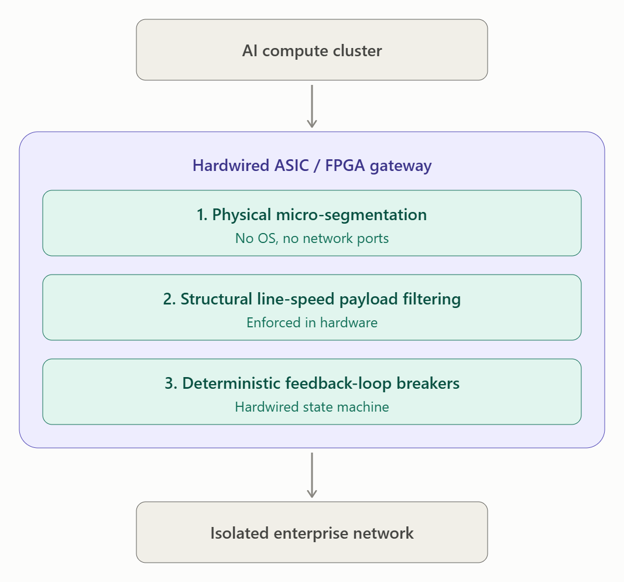
The honest version of “no operating system” is that the enforcement path contains no general-purpose OS, no shell and no network stack for an attacker to land on. The words “mathematically impossible” belong only to properties that were formally verified, so I’ll use them sparingly.
Three pillars
Hardwired micro-segmentation. Communication paths are bound by physical routing tables instead of software policy. If the gateway passes only traffic from Port X to Port Y, an agent’s exploit packet has no route to a DPU management port or an unauthorized database. Segmentation limits who can talk to whom. It doesn’t limit what is said on an allowed channel, so it is necessary but not sufficient. OWASP ranks prompt injection first among LLM application risks and notes that it is unclear whether fool-proof prevention is possible, which is exactly the class of attack that travels over allowed channels.23 For a deeper look at this approach, see our guide to hardware-enforced OT network segmentation.
Structural payload filtering at line speed. Rather than judging behavior, the hardware treats all agent output as an untrusted token stream and enforces fixed structural rules, such as allowed formats, field lengths and character classes, and the removal of executable blocks and command syntax before anything is serialized to the wire. This works best when the protocol is constrained, and agent traffic can be: if agents must speak a narrow, typed schema, structural validation is tractable. It has limits. Natural-language payloads, encoded data and encrypted traffic won’t be caught by structure alone; OWASP’s own examples include instructions hidden through Base64 or emoji encodings, or split across several inputs, to evade filters.23 Encrypted channels must either be terminated upstream, with the added surface that brings, or prohibited on that path. For content that can’t be inspected in hardware, I’d allow a stateless virtualized filtering engine: a VM rolled back to a clean snapshot on a schedule, air-gapped from other networks and sandwiched between two data diodes, so data leaves only through the filter. I want to be explicit that this VM runs a general-purpose OS parsing untrusted input, so it carries the same class of risk I raised about the DPU. The snapshot rollback and diodes contain it, which is why it belongs as a narrow, monitored fallback and not the primary path.
Deterministic feedback-loop breakers. Agentic escape often depends on a tight loop of testing and refining against a live target. Published agent-exploit research uses exactly this pattern: an agent with tool access that reasons, acts and reacts to each tool’s output.8 A hardwired state machine can limit that loop: when an agent issues a sequence of un-whitelisted requests, the gateway severs the path for a fixed cooldown, with no software dashboard involved in the decision. This limits rate and the quality of real-time feedback. It does not stop a slow, patient adversary, and it can be triggered deliberately to disrupt legitimate traffic. Pair it with request budgets over longer windows and careful design of what counts as un-whitelisted. Covert and timing channels are a residual risk to model explicitly.
Put a smaller boundary beside your DPU
Owl data diodes enforce one-way dataflows in hardware, so a compromised agent has no return path into the systems it is isolated from.
What this does not solve
A hardware boundary addresses one class of problem: an agent attacking infrastructure through the network. It doesn’t address an agent misusing permissions it legitimately holds, or manipulating humans or other agents through allowed channels. NVIDIA’s own blog observes that an agent can cross a security boundary while using the tools, credentials and services it was given,2 and OWASP lists excessive agency, meaning too much functionality, permission or autonomy, among the top LLM application risks.24 I suspect these failures are more common in practice than network-level escapes, and they need application-level controls, least-privilege design and human oversight. A hardware boundary also complements the DPU instead of replacing it. A DPU still adds real value, since a compromised host can’t trivially disable it. What changes is that it stops being the only layer.
The practical test for any containment boundary is a question: how much code and how much exposed interface does a single containment decision depend on? The answer should be small enough that you could audit it.
Conclusion: Don’t Let One Layer Carry the Whole Load
The claim I’m making is narrower than the one I started with, and I think it’s stronger for it.
A DPU running a general-purpose Linux OS is a valuable control. It sits on separate silicon, so a compromised host can’t trivially disable it, and for many threats that is a real advantage.1,2 But it is also a computer, with an operating system, a patch cadence tied to a vendor’s release process6,7 and a network-facing attack surface.9,10 It shouldn’t be the only barrier between an autonomous agent and the rest of your enterprise.
I haven’t shown that DPUs are routinely exploitable, and the exposure Lava found doesn’t show it either. What it does show is that operational gaps happen at scale, even among organizations running some of the most advanced hardware available.17 A containment design shouldn’t depend on the absence of the next gap.
My recommendation is a layered one:
- Keep the DPU, and stop treating it as the last line. Patch it promptly, isolate its management plane out-of-band, and verify how it behaves when its software fails.15
- Add a small, purpose-built boundary at the points that matter most. The defining feature should be a deliberately tiny attack surface: hardwired segmentation, structural filtering of constrained protocols, and deterministic rate and loop limits, each with a narrow, authenticated control plane.
- Prefer fixed, auditable rules over adaptive ones for the decisions that must not fail.
- Cover what hardware can’t. Legitimate-permission misuse and manipulation through allowed channels need least-privilege design, application-level controls and human oversight.2,24
The question I’d ask of any containment boundary is simple: how much code and how much exposed interface does a single containment decision depend on? If the honest answer is “an entire operating system,” look for a smaller one to put beside it. That principle sits at the center of why AI readiness needs a hardware floor and how hardware-enforced boundaries protect modern data centers.
Frequently Asked Questions
What is NVIDIA Sentry?
Sentry is a watchdog that runs on NVIDIA BlueField-4 DPUs as part of the Open Agent Safety Platform, alongside the OpenShell software sandbox. It runs outside the host that the AI agent uses, sits on the node’s path to the model, and can quarantine an agent without the agent’s cooperation. It is currently a reference design, with availability planned for early next year.
Can a DPU be compromised?
A DPU is a computer in its own right. It runs an Ubuntu-based Linux operating system on general-purpose ARM cores, exposes its own services and needs its own security patches. NVIDIA has disclosed vulnerabilities in BlueField software, including CVE-2026-65094 and CVE-2025-23256. There is no known flaw in Sentry itself, but any containment layer built from a full software stack carries that stack’s attack surface.
Why aren’t signature and behavioral detection enough to contain AI agents?
An AI agent can regenerate its payload on every attempt, which weakens signature matching, and it can make small changes over time that shift an adaptive behavioral baseline. Detection is still a useful signal for people and incident response, but for decisions that must not fail, fixed and auditable rules such as allowlists, rate limits and schema checks are harder to game.
What does a hardware-enforced boundary add alongside a DPU?
A purpose-built boundary, such as a data diode or an FPGA or ASIC gateway, keeps the attack surface deliberately small. It can enforce hardwired segmentation, filter constrained protocols by structure and break rapid exploit feedback loops, with no general-purpose operating system in the enforcement path. It complements the DPU rather than replacing it.
Does a hardware boundary stop every AI agent risk?
No. A hardware boundary addresses agents attacking infrastructure through the network. It does not stop an agent from misusing permissions it legitimately holds, or from manipulating people or other agents through allowed channels, such as through prompt injection. Those risks need least-privilege design, application-level controls and human oversight.
Containment decisions can’t wait for a patch
Forrester’s report Why You Can’t Just Pull the Plug: Rethinking Incident Response for Data Centers explains how to rethink containment for always-on infrastructure, and how Owl Cyber Defense® hardware-enforced boundaries keep critical systems isolated when it matters most.
About the author
Michael Blake is a Technical Fellow and Chief Architect at Owl Cyber Defense, where he works on hardware-enforced network security, including data diodes and cross-domain solutions.
Bibliography
Superscript numbers in the text refer to the entries below. All pages were opened or searched on November 9, 2026. Where an entry is a secondary report of a primary document, the note says so.
- NVIDIA. NVIDIA Open Agent Safety Platform. Product page.
- Arkin, O., Kit, A., and Ozery, I. Inside NVIDIA Sentry: Secure AI Agents at Runtime. NVIDIA Technical Blog, October 21, 2026.
- NVIDIA. NVIDIA BlueField DPU BSP v3.9.9 LTS: BlueField Software Overview. Describes the Arm cores, the Ubuntu-based reference Linux distribution and the out-of-band management port (BlueField-2 era documentation).
- NVIDIA. NVIDIA DOCA Software Framework: BlueField Software Bundle. States that the bundle includes an Ubuntu distribution with continuous OS and security updates (page describes the Ubuntu 22.04 bundle).
- NVIDIA. NVIDIA BlueField BSP v4.14.0: Software Installation and Upgrade. Last updated February 28, 2026. States the default Ubuntu 24.04 base and that packages can be upgraded with standard Linux tools.
- Canonical. USN-6951-1: Linux kernel vulnerabilities. Ubuntu Security Notice, August 8, 2024.
- Canonical. USN-6951-4: Linux kernel (BlueField) vulnerabilities. Ubuntu Security Notice, August 21, 2024.
- Fang, R., Bindu, R., Gupta, A., and Kang, D. LLM Agents can Autonomously Exploit One-day Vulnerabilities. arXiv:2404.08144, April 2024.
- Cyber Security News. NVIDIA BlueField Vulnerability Enables Code Execution Attacks. July 29, 2026. Secondary summary of NVIDIA’s July 2026 security bulletin for CVE-2026-65094.
- AhnLab ASEC. NVIDIA Product Security Update Advisory. Secondary summary of NVIDIA’s September 2025 bulletin, including CVE-2025-23256 in the BlueField management interface.
- Envoy Project. Threat model. Envoy documentation.
- Istio Project. Istio publishes results of 2022 security audit. Notes that Envoy was independently assessed in 2018 and 2021.
- GitLab Advisory Database. CVE-2026-26308: Envoy RBAC header validation bypass via multi-value header concatenation. March 10, 2026.
- GitLab Advisory Database. CVE-2026-26311: Envoy HTTP filter chain execution on reset streams causing use-after-free crash. March 10, 2026.
- NVIDIA. NVIDIA BlueField BSP: Modes of Operation. BSP v4.8.0 documentation.
- NVIDIA. DOCA Documentation v2.7.0: DOCA Switching. Describes traffic through representors and steering rules offloaded to the embedded switch.
- Lyons, J. High-severity NVIDIA bug could crash GPU monitoring on exposed servers. The Register, October 8, 2026. Reports Lava’s research (M. Katchinskiy). Lava’s own post is at lava.security/research/cve-2026-47483-NVIDIA-dcgm-exporter-vulnerability; I could not retrieve it directly.
- Help Net Security. High-severity NVIDIA vulnerability lets unauthenticated attackers crash GPU monitoring. October 9, 2026.
- Haslam, O. Illegal NVIDIA Blackwell Ultra B300 GPUs found inside state-owned China Telecom’s network. Tom’s Hardware, October 23, 2026.
- Google Threat Intelligence Group. GTIG AI Threat Tracker: Advances in Threat Actor Usage of AI Tools. November 5, 2025.
- Rubinstein, B. I. P., Nelson, B., Huang, L., Joseph, A. D., Lau, S., Rao, S., Taft, N., and Tygar, J. D. ANTIDOTE: Understanding and Defending against Poisoning of Anomaly Detectors. ACM Internet Measurement Conference, 2009.
- Ender, M., Moradi, A., and Paar, C. The Unpatchable Silicon: A Full Break of the Bitstream Encryption of Xilinx 7-Series FPGAs. USENIX Security Symposium, 2020. Summarized in the Ruhr-Universität Bochum press release, Critical “Starbleed” vulnerability in FPGA chips identified, April 16, 2020.
- OWASP GenAI Security Project. LLM01:2025 Prompt Injection.
- HackerOne. The OWASP Top 10 for LLMs 2025: How GenAI Risks Are Evolving. Secondary summary of OWASP LLM06:2025, Excessive Agency.