In the world of secure data sharing, the hardest part isn’t building the walls, it’s translating across them.
As legacy systems, proprietary protocols, and outdated formats pile up, mission-critical operations increasingly rely on the ability to parse, filter, and transform data that was never designed to interoperate. For decades, Mike Beckerle has been solving that problem not with another closed system, but with an open standard: DFDL, and its powerful implementation, Daffodil.
As Mike prepares to retire at the end of 2025, we’re taking a moment to reflect on a career defined not only by innovation, but by an unwavering belief in the power of open communities to solve big problems together.
A Tower of Babel and a Blueprint Out
Structured data in any community, but especially the defense and intelligence community is rarely straightforward. Many fixed-format message structures, used in everything from logistics to targeting, were built decades ago and remain deeply embedded in how systems communicate today. The problem is that each one is different, proprietary, and difficult to parse without custom, one-off tooling.
Mike recognized this early in his career. Working alongside a group of likeminded engineers from across government and industry, he helped develop and advocate for DFDL, the Data Format Description Language, as a way to describe any data format in a standard, reusable, machine-readable way.
Out of this effort came Daffodil, the open-source implementation now stewarded by the Apache Software Foundation. Daffodil transforms fixed-format data into XML, allowing organizations to apply standard XML tools like filters and validators without custom code for every format. As Mike wrote earlier this year, “we’re leveraging an extensive pool of talent to make something better” for the mission at hand.
Open by Design, Trusted by Community
Daffodil was not just a technical solution. It was a values-driven decision. Mike pushed for an open-source foundation to give all vendors and mission partners equal footing. In a space often dominated by proprietary formats and vendor lock-in, this approach was a breakthrough.
Why open source? Because real security and reliability come from visibility, shared responsibility, and a deep talent bench. In Mike’s words:
“With DFDL, you’re not locking into one vendor’s proprietary formatting. You’re benefiting from the liberation of data in multiple formats, made possible by a community with wide-ranging technical experience and knowledge bases.”
This approach, favoring collaboration and shared standards, has enabled new tools to emerge and created a more agile and resilient ecosystem for secure data transfer.
A Legacy of Impact and Mentorship
Inside Owl Cyber Defense, Mike has long been regarded as more than an engineer. He has been a mentor, a teacher, and a steady hand in navigating complex challenges. One colleague described him as “the kind of engineer who doesn’t just solve hard problems, he teaches you how to think through them.”
Mike’s impact extends far beyond Owl. His work has helped shape how cross domain filtering handles structured data, enabling secure and efficient information transfer where it matters most. He has contributed code, standards, documentation, and, perhaps most importantly, clear thinking.
During a recent internal recognition, a longtime collaborator presented Mike with a few lighthearted gifts. These were small mementos, but they reflected deep respect. What truly defines Mike’s legacy is not the tokens, it’s the path he created for others to follow.
Looking Ahead
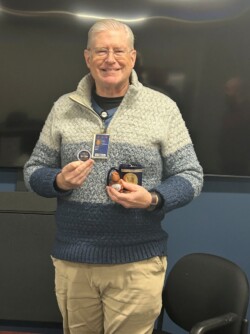 Mike’s last day at Owl will be December 31, but Daffodil and the spirit behind it will continue to grow. Thanks to the open-source community and the strong foundation Mike helped build, Daffodil is well positioned to adapt to future challenges in secure data sharing.
His work is a reminder that the best solutions are the ones that invite others in, encourage collaboration, and remain flexible over time.
From all of us, thank you, Mike. You didn’t just build tools. You built trust, community, and a lasting path forward.
Read Mike’s original blog: Why Open Source Software is Critical for Cybersecurity
Hear more from Mike about his career and mission-driven work on the Tech Transforms podcast.